



6 GDPR Compliance Principles You Need to Master


Organisations may face serious financial, legal, and reputational risk if they do not comprehend and implement GDPR compliance principles. GDPR requirements adherence is a board-level concern rather than just legal, technical and organisational measures because maximum fines and regulatory penalties for non-compliance can reach up to 4% of global annual turnover.
The difficulty for many organisations is not in appreciating the significance of data protection, but rather in incorporating its tenets into daily operations, system design choices, and operational procedures. Cross-functional cooperation, ongoing oversight, and organised governance are necessary for effective GDPR compliance.
What Is GDPR
The General Data Protection Regulation is a major aspect of EU data protection law that regulates the gathering, handling, and retention of personal data.
It applies not only to the organisations set up in the European Union but also to outside companies that are processing the personal customer data of the UK or EU residents.
The General Data Protection Regulation is designed to protect the data privacy of people living in the European Economic Area and the United Kingdom. Whether it applies to specific cases depends on the characteristics of the data collection, processing and protection, not merely on the place where the business is located.
Adhering to GDPR should not be viewed as a 'one-time deal'. Different requirements come from various industries, business structures, and national laws. Hence, ongoing compliance, continual governance and monitoring are indispensable.
Purpose of GDPR and Scope of Protection
The main goal of GDPR is to protect anything considered personal data - customer information that may be used to identify individuals, whether directly or indirectly. It covers any piece of information that allows the identification, profiling, or tracking of a person.
According to GDPR, organisations that gather and use personal data are covered by the law. It was pointed out that anonymous and non-personal data are not subject to the regulation because these two kinds of data cannot be linked to a specific identifiable individual.
In GDPR, there are three primary roles in data processing:
- data subjects - people whose personal data is being collected;
- data controllers - organisations that decide why and how personal data is being processed;
- data processors - organisations or systems that process data on the controller's behalf.
Any system, instrument, or procedure that gathers personal data in the European area must be in line with GDPR standards.
Six Core GDPR Compliance Principles
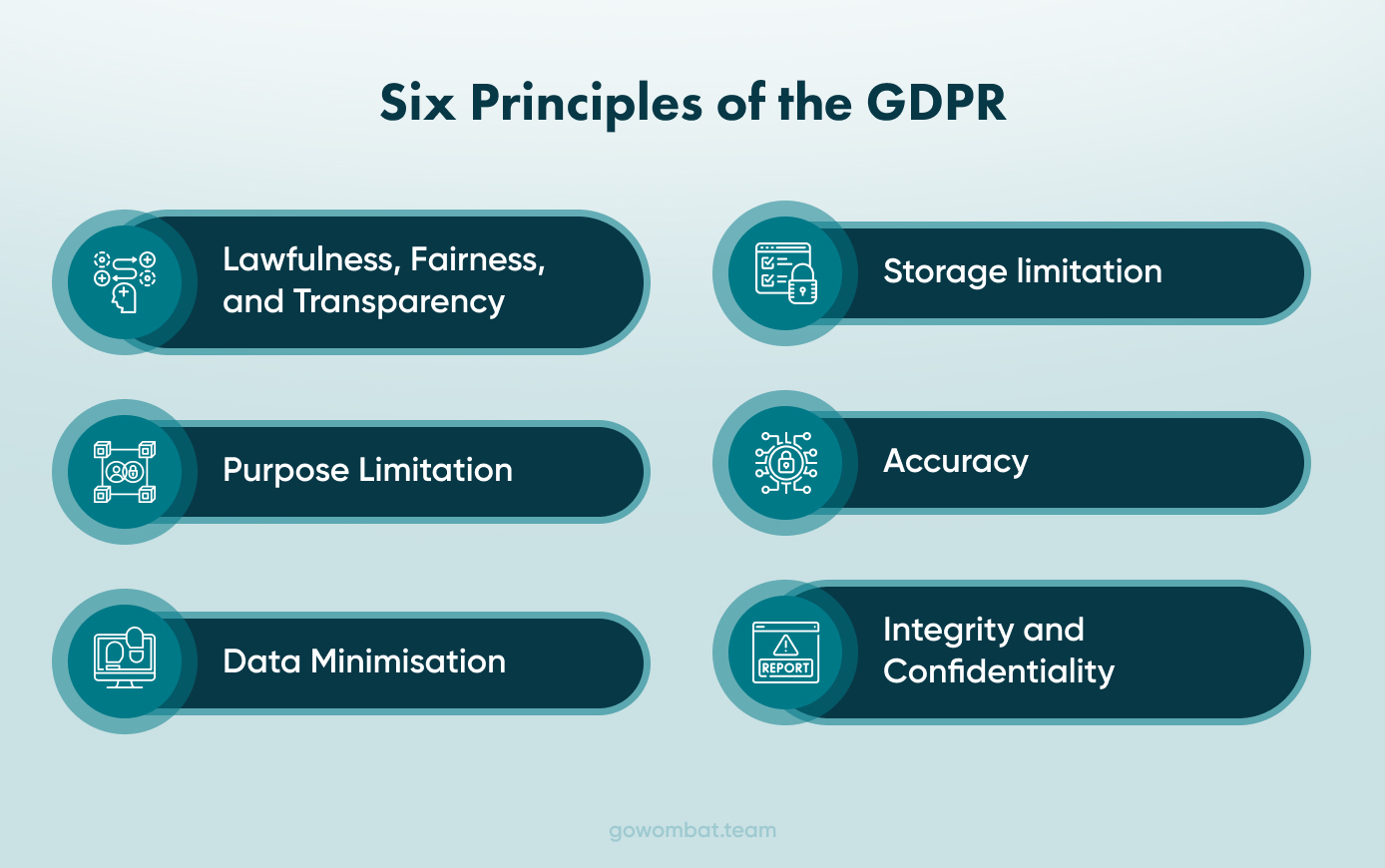
GDPR is mainly focused on six core principles that all data processing activities must be legal, ethical, and accountable.
1. Lawfulness, Fairness, and Transparency
Personal data must be processed lawfully, fairly, and transparently. Organisations are required to clearly explain: what data is collected and why, how it is processed, and whether it is shared with third parties.
Privacy policies have to be easily available, understandable, and complete. Transparency is not just a good nice-to-have point; it is due diligence for lawful processing.
2. Purpose Limitation
Personal data should only be collected for specific, clearly stated, and legitimate purposes. Organisations are not allowed to process the data in a way that would be incompatible with the original justification.
This principle obliges an organisation to:
- define processing purposes clearly;
- avoid secondary or hidden uses of data;
- limit storage to what is necessary for those purposes.
3. Data Minimisation
An organisation should only ask for personal data that is relevant and necessary for its business activities. Collecting too much data is a risk, and it makes compliance harder.
Data minimisation helps:
- reduce exposure of sensitive personal information;
- simplify methods of access control,
- optimise use of storage and maintenance,
- improve internal accountability.
4. Data Retention
Personal data should only be kept as long as necessary. Retention period should always be justified and documented.
In order to comply, the organisations should:
- set up retention schedules depending on the types of data;
- have data erased or masked when no longer needed;
- avoid selling or reusing personal data without explicit consent.
5. Accuracy
Organisations must make sure that personal data is correct and current at all times. Being in possession of wrong information can cause harm, disputes, and may even result in regulatory breaches.
Good accuracy management entails:
- clearly established procedures for updates and validations;
- recording of the sources of data and their changes;
- keeping track of correction requests;
- providing data subjects with ways to update their information.
6. Integrity and Confidentiality
Appropriate technical and organisational measures should be taken to protect personal data. Organisations have to prove that appropriate security measures are in place to protect the data from illegal access, loss, or damage.
These rules require a mix of data protection and cybersecurity practices. If the data cannot be stored securely, it should not be collected.
Accountability as a Foundational Principle
Besides the six core principles, GDPR rules lay considerable emphasis upon accountability.
Organisations have to demonstrate their compliance through not only technical measures, but also documentation, governance structures and operational controls.
Typically, accountability is strengthened by:
- internal policies and procedures;
- documented risk assessments;
- audit trails and data access logs;
- adherence to standards such as ISO 27001 and ISO 27701.
Why GDPR Principles Matter for Organisations
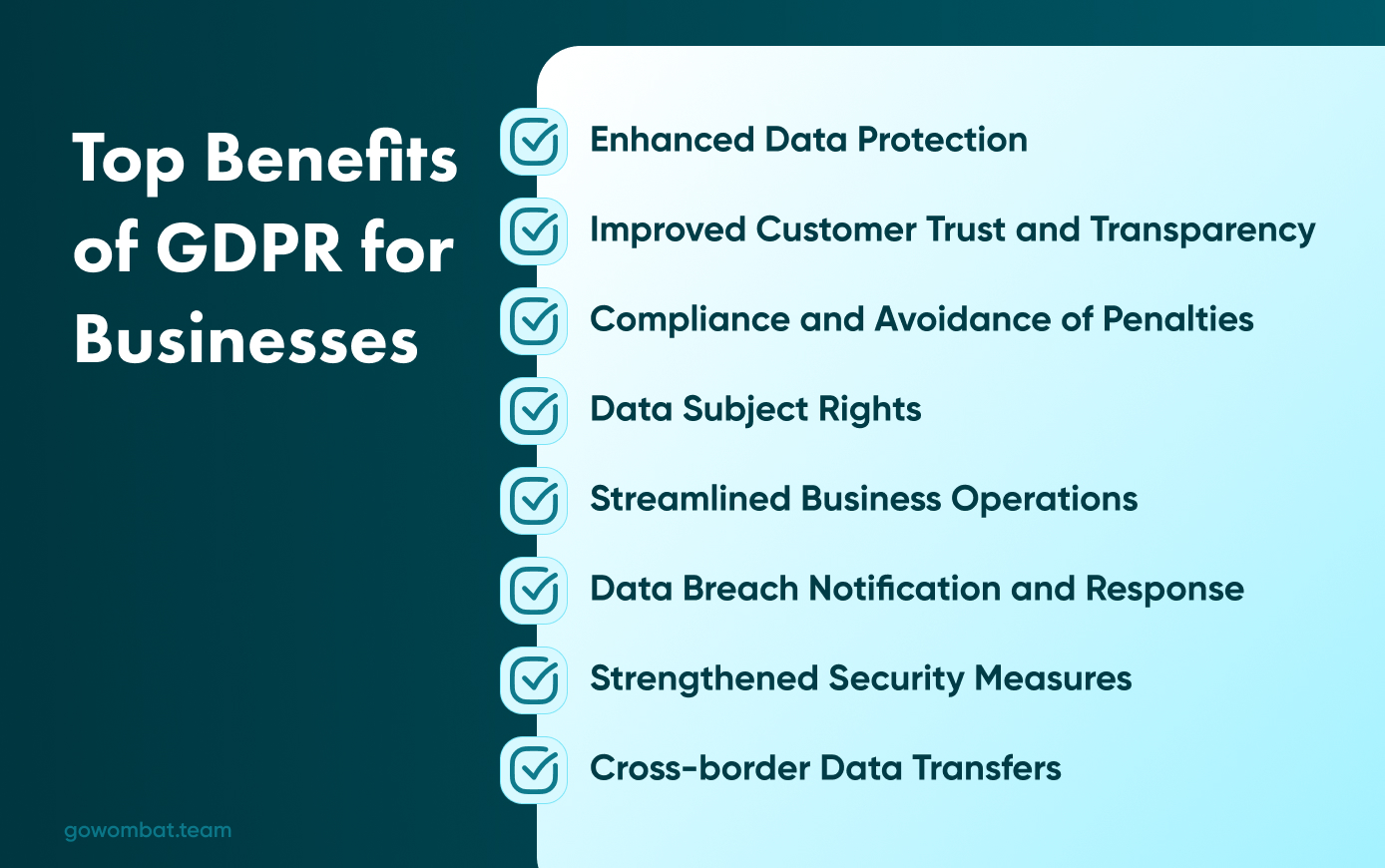
The principles of GDPR offer an organised framework for the responsible management of personal data across teams, systems, and business operations. They lower uncertainty in data-driven decision-making and establish precise limits for legal processing.
GDPR principles are important for organisations because they:
- minimise exposure to fines and enforcement actions;
- reduce regulatory ambiguity across departments;
- support coordinated decision making between legal, technical, and product teams;
- establish consistent rules for data governance.
A strong commitment to GDPR principles serves as a signal of trust as well. Regulators, partners, and enterprise clients increasingly assess organisations based on the maturity and transparency of their data practices, not merely on formal compliance.
By putting GDPR requirements into practice, organisations can:
- Integrate security and privacy into system architecture.
- Keep records of decisions and show responsibility.
- React to audits and investigations with assurance.
- Align innovation with ethical and regulatory expectations.
What Happens When Organisations Ignore Required GDPR Controls
Several enforcement cases under the GDPR blatantly reveal that organisations suffered the consequences of neglecting even the most basic, well-known data protection and security measures. The EU regulators in the case against Clearview AI decided that the company collected and processed personal data without a lawful basis, transparency, or appropriate risk assessment procedures, which eventually resulted in the company being banned and handed enormous fines. Not much different, Meta Platforms has been fined several times for continuing to transfer data even after the regulators had clarified the requisite safeguards in their guidance, which has led to the largest penalties being imposed on the company.
These cases were based on deliberate disregard of the GDPR obligations over time. It also included the absence of DPIAs, poor governance and failure to implement operational and technical controls in their systems in accordance with the regulatory requirements.
Who Does GDPR Apply To
Regardless of the organisation's location, GDPR compliance is required for any organisation that processes personal data pertaining to UK or EU residents.
In actuality, GDPR covers:
- companies that sell goods or services to UK or EU citizens;
- organisations monitoring behaviour within the EU or the UK;
- companies that process customer, employee, or partner data;
- data processors that supply technology or services;
- vendors and subcontractors who have access to data.
Compliance obligations span the whole supply chain and data lifecycle. Data controllers and processors must implement data protection, outline duties, and guarantee third-party compliance.
Benefits of GDPR Compliance for Small and Medium Businesses
For medium and small businesses, ensuring GDPR compliance can provide real benefits if the company sees it more as a strategic opportunity rather than simply a way to defend against the EU law.
The key advantages are:
- greater confidence of customers and business partners;
- less exposure to significant fines, lawsuits, and damage to the company's image;
- more clearly defined internal responsibilities for the handling of data;
- better data quality and a more disciplined approach to data management.
In addition, GDPR can be a great way to help a company develop more sustainably. It does so by preparing organisations for audits of internal systems and enterprise partnerships, reducing data remediation costs, aligning operations with privacy-by-design principles and strengthening credibility in competitive markets.
How to Prove Compliance and Protect Personal Data
Almost every type of organisation collects personal data these days. Hospitals keep patient records. Banks handle financial info. Schools store student details. Online platforms log what users do. It’s just part of how things work now.
However, at the same time, organisations need to show that personal data management aligns with GDPR principles and is done responsibly. Compliance is not something that can be taken for granted; it has to be demonstrated.
Data Protection Impact Assessment is one of the most practical tools that also serves as proof of compliance. DPIA procedures enable organisations to:
- identify personal data processing activities;
- assess risks to data subjects' rights;
- define and document mitigation measures;
- demonstrate accountability to regulators.
DPIA helps organisations establish processes that reduce uncertainty and create a clear compliance trail.
How Go Wombat May Help You With GDPR Compliance
At Go Wombat, we deliver GDPR consulting services through a carefully structured yet personalised approach that is in line with cybersecurity and data governance best practices.
Our approach includes initial consultation and scoping, risk assessment and gap analysis, tailored compliance strategy, documentation and governance support.
When partnering with Go Wombat, you receive not only your GDPR readiness assessment, privacy policy creation or internal GDPR compliance management system - you get a trusted partner with substantial experience in the EU market. If you want to understand where your organisation stands and what level of GDPR compliance is actually required, schedule a call with our team to discuss your specific context and next steps.
To sum up
GDPR has been set up as a full-scale, detailed regulatory scheme to protect people's data and give a strong push to their rights in the online market. Being compliant is not just about studying the laws; it is about having a well-planned administration, secure IT infrastructures, and regular supervision.
Companies that consistently implement the core principles of the GDPR significantly decrease their exposure to legal sanctions and data breaches, gain more confidence and customer trust, and conform to today's standards of data accountability. In the face of increasing regulatory pressure and user enlightenment, ensuring GDPR compliance turns into a need to stay competitive.
FAQs
Is a privacy policy enough alone to be GDPR compliant?
No, a privacy policy is just a part of GDPR compliance. Besides that, organisations need to put in place internal processes, access controls, data retention policies, breach notification and response procedures, and accountability mechanisms to prove that they are actually compliant.
What is the difference between GDPR compliance and data security?
GDPR compliance is mainly concerned with lawful processing, individual rights, and accountability, whereas customer data security is about protecting data from unauthorised access and data breaches. Strong security measures are necessary, but do not guarantee compliance.
When is a Data Protection Impact Assessment necessary?
A DPIA is mandatory if the processing of personal data is likely to pose a high risk to the rights and freedoms of the data subjects. This generally entails large-scale processing, sensitive data categories, behavioural monitoring, or the use of new technologies.
How long does it typically take to implement GDPR compliance?
The timeline depends on organisational size, industry, data complexity, and existing controls. Initial readiness assessments may last only a few weeks, while full implementation and governance alignment might take several months or more.
How often should GDPR compliance be reviewed?
It should be continually tracked via monitoring and formally evaluated after changes in systems, introduction of new data processing agreements, regulatory updates, or security and data breaches.
Can GDPR compliance support enterprise sales and partnerships?
Certainly. Being able to prove GDPR compliance builds trust among enterprise clients, facilitates the procurement process, and is, in fact, a requirement for partnerships and vendor relationships in regulated industries.
What documentation is needed to prove GDPR compliance?
Common documentation includes privacy policies, DPIAs, data processing logs, consent records, access control policies, incident management processes, and internal governance documents.
Is it possible to outsource GDPR compliance?
You cannot delegate the responsibility for compliance, but professional partners may help with assessments, documentation, governance design, and implementation while the organisation keeps the accountability.
Is a Data Protection Officer necessary for every company?
Not all organisations have to appoint a DPO. A DPO is compulsory if the main activities involve large-scale monitoring or processing of sensitive personal data. However, many companies choose advisory DPO services to improve their governance.
Does GDPR entail ISO certification?
No, but following ISO-based practices enhances accountability and makes audits easier, thus, it is a wise choice.
Share and subscribe to our blog
Related articles

Similarities, Differences, and Everything You Need to Know About GDPR and HIPAA Compliance
If your company leverages digital tools it means that you have to comply with the regulations of the region you work in. For example, if you are gathering, storing, or processing the personal information of European Union (EU) residents, y…

How to Achieve ISO 27001 Certification in 2026?
ISO 27001 certification follows a well defined procedure to demonstrate that your organisation adheres to globally recognised ISO (International Organisation for Standardisation) standards for information security. The certification involv…

Continuous Security Monitoring (CSM)
W hat is it and how can your business benefit from it? Businesses are constantly needing to adapt to new conditions. One of these conditions and their changes is theft and loss of data. In 2022, the of dat…

How can we help you ?