



How to Achieve ISO 27001 Certification in 2026?

ISO 27001 certification follows a well-defined procedure to demonstrate that your organisation adheres to globally recognised ISO (International Organisation for Standardisation) standards for information security. The certification involves creating a documented Information Security Management System, successfully going through an independent ISO audit certification, and continually staying compliant. At Go Wombat, we assist enterprise product teams working in regulated industries by incorporating ISO compliance, ISMS, PIMS, and GDPR alignment straight into technical architecture, operational governance and all organisational processes.
Why ISO 27001 Certification Matters for Enterprise Teams
Cyber attacks are not just a distant threat anymore. The IBM Cost of a Data Breach Report 2023 stated that the worldwide average cost of a data breach was USD 4.45M, which demonstrates the huge financial loss and damage to the reputation of companies that have poor information security controls.
For CTOs and product leaders, an ISO 27001 certification is more than just ensuring compliance with international standards, creating an Information Security Management System or training employees on how to behave with sensitive information. It is a matter of unlocking the market, speeding up the procurement process, and earning the trust of regulators, existing customers and new clients.
Enterprise buyers are increasingly demanding:
- the proof of harmonisation with internationally accepted standard frameworks;
- the independent verification by a licensed ISO certification or accreditation body;
- the evidence of demonstrated governance, besides mere technical controls implemented;
- the well-structured documents that are in accordance with the ISO guidance.
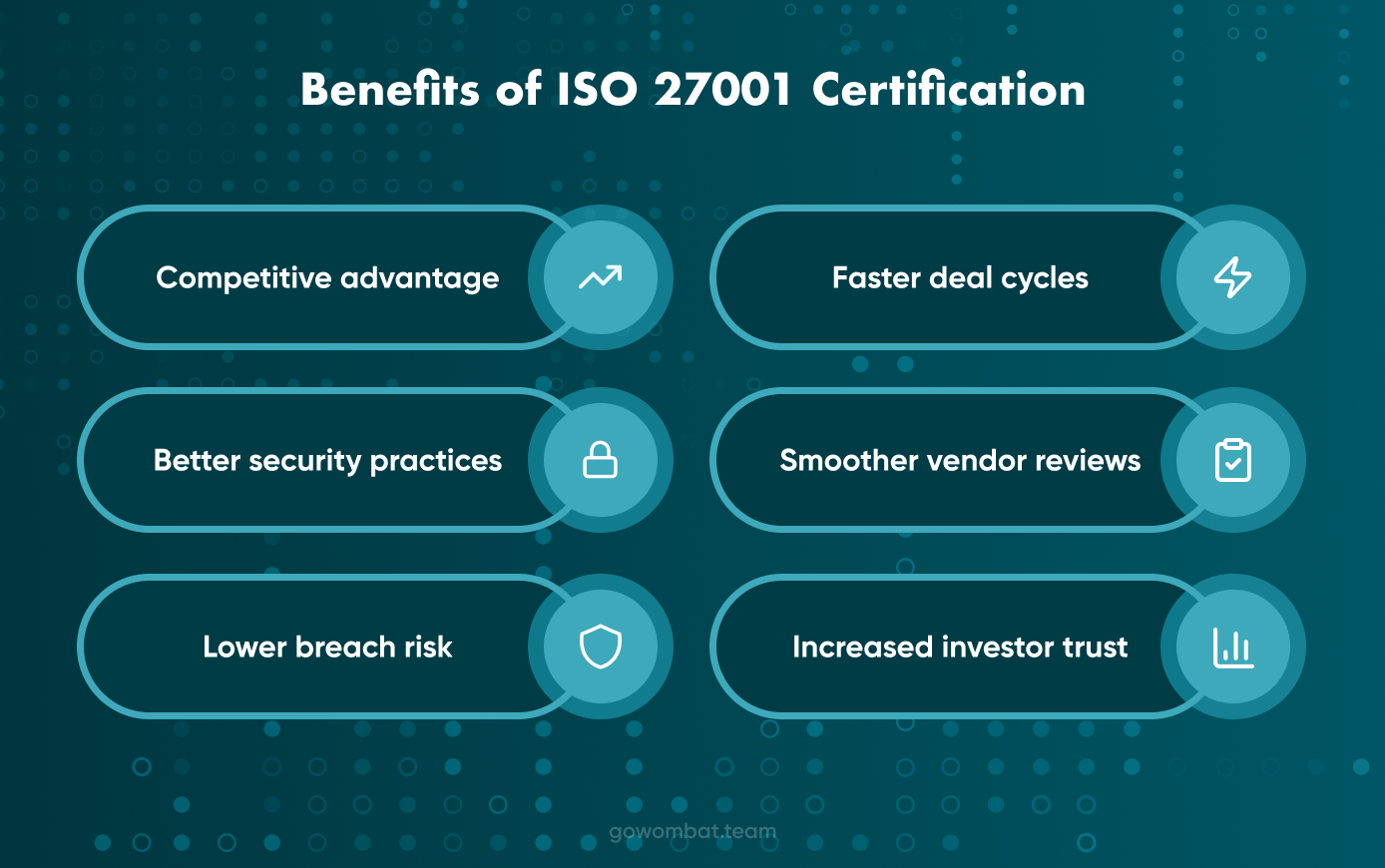
ISO certified companies are known to have an easier time during vendor risk assessments, to get contracts signed more quickly, and to enjoy stronger credibility, especially in EU-regulated markets.
ISO 27001 certification can be seen almost as a stepping stone in the fintech, healthtech, SaaS infrastructure, and mobility sectors at the very least.
What Is the ISO 27001 Certification Process?
What Are the Official Stages of ISO Certification?
The ISO 27001 certification process has a defined sequence of steps that are regulated by global standards and verified by an independent ISO auditor.
The main stages are:
- Determining the Information Security Management System scope.
- Performing a formal risk assessment and gap analysis.
- Choosing and recording controls in the statement of applicability.
- Demonstrate compliance with operational and technical security practices.
- Carrying out an internal audit.
- Annual and biannual audits by the external audit team.
- Maintaining compliance through continuous monitoring and surveillance audits.
Certification audit focuses on documentation readiness. The following recertification audit is a real operational effectiveness assessment. Surveillance audits are annual, and the full recertification usually takes place every three years. The involvement of an accredited certification body guarantees that the certification services comply with internationally recognised standards, thereby enhancing stakeholders' trust across different jurisdictions. There is an advantage in this process due to its thoroughness. The difficulty is consistency in documentation maturity and the ability to coordinate cross-functional teams.
How Much Does ISO 27001 Certification Cost?
ISO 27001 certification cost depends on such factors as scope, size of the organisation, technical complexity, and internal preparedness.
Costs usually include:
- external ISO audit certification fees;
- certification consultants or advisory services;
- ISO internal auditor certification training;
- internal resource allocation;
- surveillance audits and recertification.
In Europe, an external audit of costs in medium, sized organizations, depending on the scope, can be between EUR 8, 000 and EUR 30, 000. Consultant support may be a further EUR 1, 500 per day. Besides these, costs for internal audits and training also have to be considered.
Nonetheless, centring on ISO 27001 certification cost alone overlooks the greater business case. The benefits of certification include lower sales resistance, less redoing of security questionnaires, and a stronger position in regulated procurement environments.
To enterprise product teams, the issue is not the cost. It is rather the question of whether not having the certificate forbids market entry.
How Do ISO Guidelines Translate into Operational Controls?
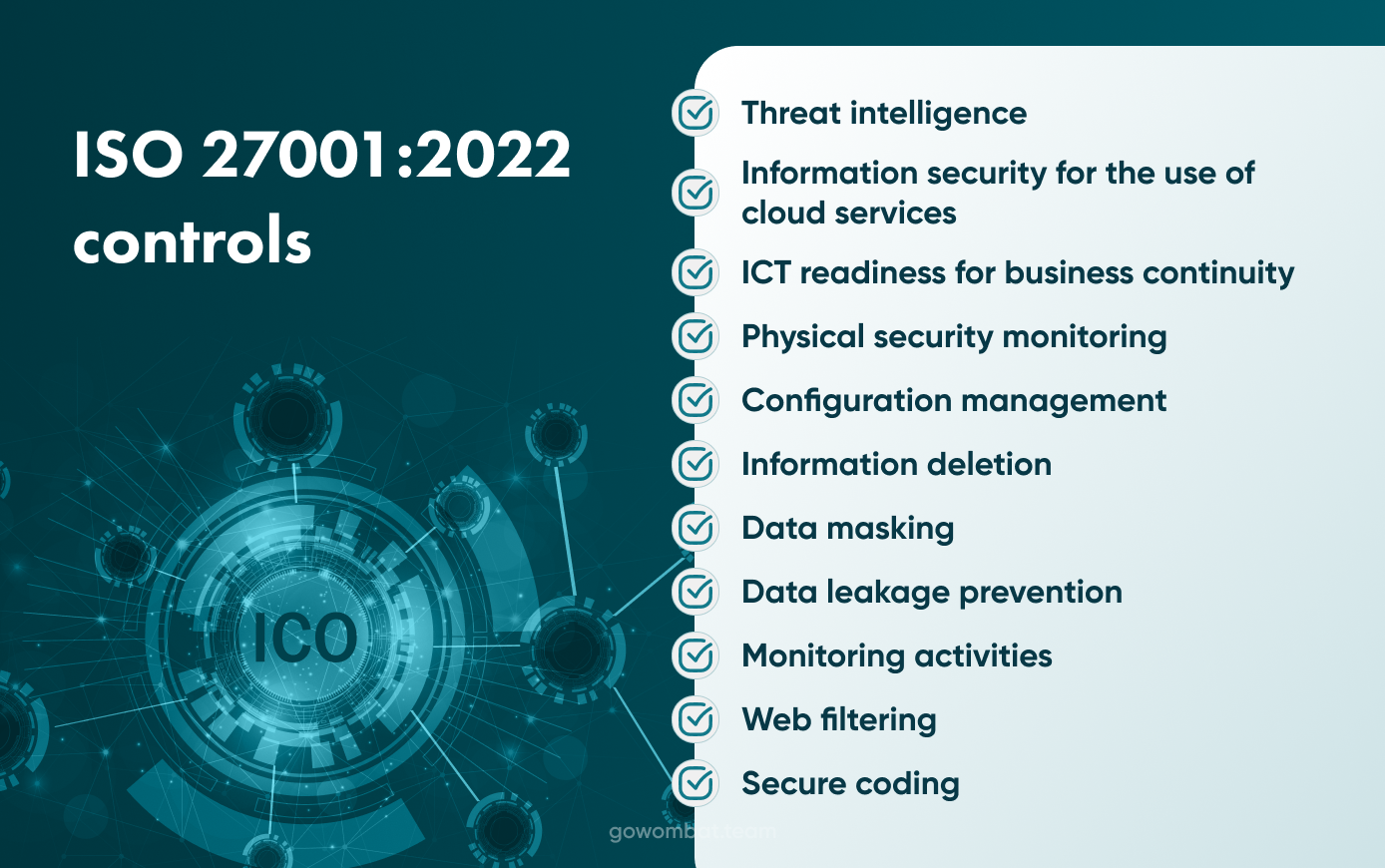
ISO standards entail more than just the creation of cybersecurity policies. They demand a structured approach to risk management, governance, and evidence of fulfilling information security management system requirements.
The basis of ISO compliance is a risk assessment. This is the process of asset identification, threat evaluation, likelihood and impact estimation, and acceptable risk level determination.
Subsequently, organisations must:
- implement controls that match the ISO standards;
- provide documentation of the justification within the Statement of Applicability;
- assign ownership of the controls;
- assess the effectiveness;
- establish a continuous internal audit process;
- evaluate the environmental performance for the business leadership.
The gap between shallow ISO compliance and full-scale implementation is operational integration.
Fully-fledged implementation implies that:
- the security objectives can be measured;
- the leadership is actively involved in the review of the ISMS performance;
- the documentation is a true reflection of the practice;
- the controls have become a part of development, operations, and vendor management.
We, at Go Wombat, recognise the success of certification when compliance is a natural fit in the product architecture and not an afterthought.
How ISO 27001 May Help to Strengthen Market Position
Salesforce
Salesforce openly advertises its ISO 27001 certification in its Trust documentation. The procurement teams of big businesses typically require vendors to produce ISO audit certification evidence before onboarding the SaaS solution. Certification is one of the ways that Salesforce can demonstrate its capacity to serve various regulated industries worldwide.
SAP
SAP is an ISO 27001-certified company with several data centres and cloud environments covered by the standard. Enterprise contracts at the world level and regulatory trust in European markets are both supported by certification.
Revolut
Revolut sought ISO 27001 certification as an aspect of the company's expansion in regulated financial services.
Business certification has been a key element of its governance. It helped its communication with EU regulators and the institutional partners.
Atlassian
Atlassian points to ISO 27001 certification in its Security Trust Centre.
By doing this, the company reduces vendor assessment cycles and speeds up the onboarding of enterprises.
These cases are all representative of the same pattern:
- companies with ISO 27001 certification eliminate procurement obstacles;
- certification strengthens enterprise trust scoring;
- the validation of an independent ISO certification body enhances the credibility;
- the maturity of the governance supports the regulated market entry.
For the CTOs and founders intending to grow their enterprise, certification is a strategic solution, not only a way to prove they're protected from common information security risks.
ISO Certification Consultants or In-House Expertise?
Organisations usually have the choice of three paths if they want to get an ISO certificate.
They can hire external certification consultants, who are experts in information security management systems and can speed up the preparation. It is a good idea if the company does not have enough knowledge of the certification process.
By obtaining an internal auditor certification, building cybersecurity becomes a long-term governance maturity process. In fact, it is the question of maintaining an ongoing process of training employees, establishing technical controls and security practices, implementing incident response and risk management and audit reporting.
Most of the time, the hybrid model can be the best option. Consultants help to set up the framework. Then, the internal teams implement and maintain it.
Nevertheless, compliance should not be a separate issue from engineering. The secure system design, access control architecture, and privacy management need to be in line with ISO standards.
Go Wombat helps enterprise clients map ISO compliance with the technical design so that the certification becomes a true reflection of real system resilience and not just static documentation.
Aligning ISO 27001 with GDPR and PIMS in the EU
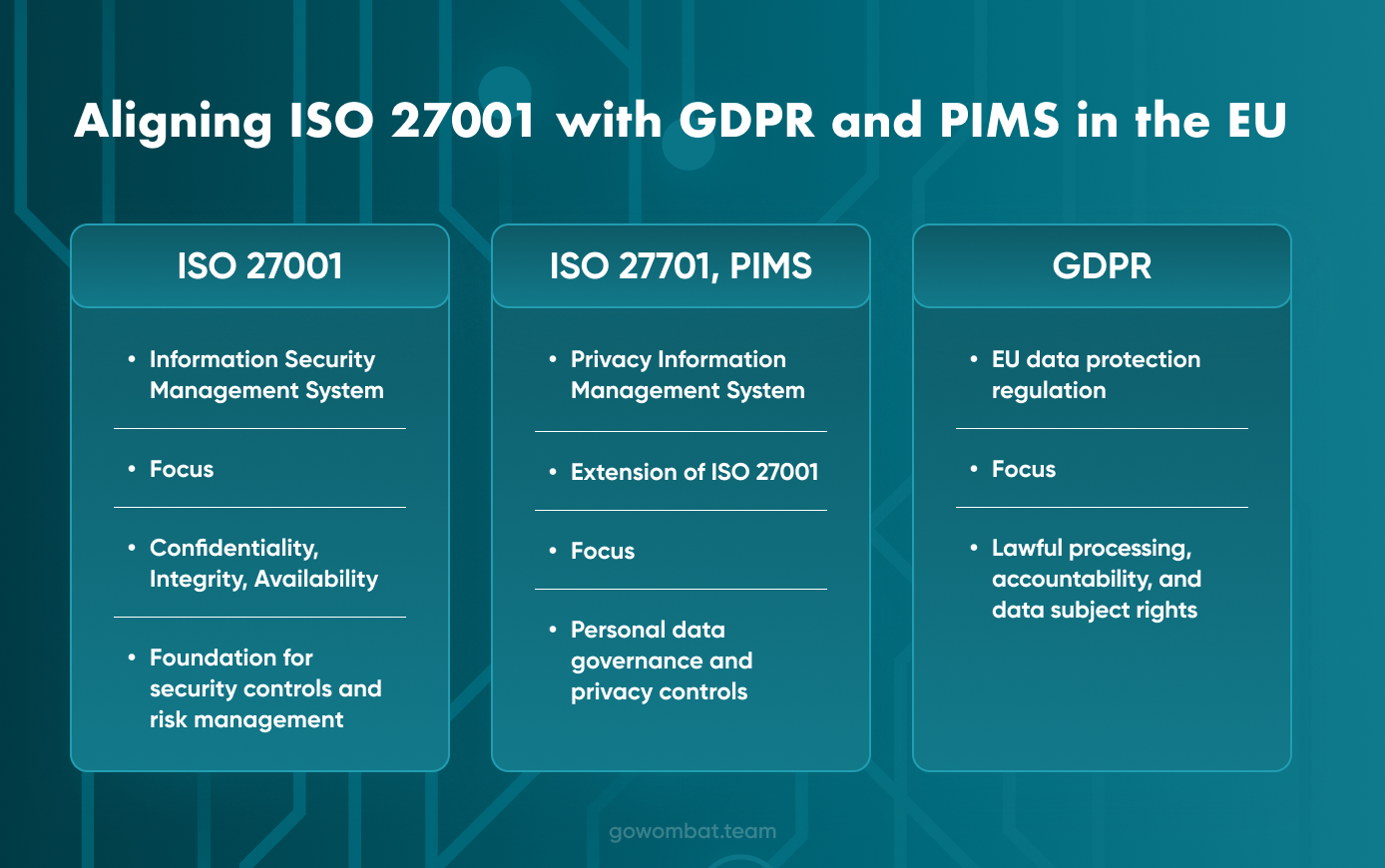
ISO 27001 is the standard that sets up a framework for an Information Security Management System, while ISO 27701 takes it further by turning it into a Privacy Information Management System. Aside from that, GDPR binds data controllers and processors with legal obligations.
Such frameworks converge for EU product teams operating in regulated industries.
ISO 27001 is about confidentiality, integrity and availability. A PIMS focuses more on privacy governance and the management of the data lifecycle. GDPR is about the enforcement of lawful processing, transparency and accountability.
In the complete alignment of these standards, you get:
- well-structured organisational processes and technical measures;
- clear regulatory documentation;
- less probability of being fined;
- more powerful reporting for the stakeholders.
In so doing, integrating ISO standards with GDPR compliance is a two-way improvement in establishing both legal defensibility and operational clarity.
Key Takeaways for CTOs and Product Leaders
- ISO 27001 certification is more than just an audit process. It serves as a strategic market access enabler.
- obtaining an ISO certification involves leadership alignment and structured governance.
- the expenses of ISO 27001 certification should be compared with the potential revenue from the enterprise and the risk reduction through regulatory compliance.
- vendor evaluation or enterprise procurement usually goes well for ISO-certified firms.
- investor, board, and regulator confidence is greatly increased by long-term ISO compliance and security system maturity.
For decision-makers, ISO certification is all about operational security standards and strategic trust as the main business benefits.
Enterprise Checklist for ISO 27001 Certification
Here are the steps to follow for effective preparation for the ISO certification process:
- get the support of the top management;
- set the limits of the ISMS scope clearly;
- carry out a formal documented risk assessment and gap analysis;
- make and keep the Statement of Applicability up to date;
- delegate the ownership of information security controls;
- provide employee security awareness training;
- conduct an independent internal audit process;
- choose an accredited ISO certification body;
- be ready for certification audit and recertification audits;
- create surveillance governance mechanisms.
This methodical plan not only makes it easier for the audit team to parse your data but also helps you to keep your audits on track and be compliant in the long run.
Conclusions
Among the most widely recognised international standards that concern information security, ISO 27001 certification tops the list. Enterprise product teams that receive an ISO certificate demonstrate governance maturity, operational discipline, and accountability.
The ISO certification procedure necessitates process documentation, risk assessment, internal training, involvement of senior management, and continuous improvement. Salesforce, SAP, Revolut, and Atlassian, among other companies, benefit from adhering to certification standards. Consistency in security management system implementation helped them to expand into the market and accelerate procurement.
Nevertheless, certification in itself is not enough. Long-term ISO compliance requires the embedding of security controls in product development, operations, and privacy management.
At Go Wombat, we partner with CTOs and compliance leaders to create secure, enterprise-ready cybersecurity systems that are in line with ISO standards, PIMS, and GDPR compliance. If your organisation is on the way to a certification audit or is considering ISO certification consultants, we will gladly support your next move.
FAQ
How do you select the right ISO certification body in the EU?
Choose a certified ISO certification body that is recognised by national accreditation authorities. Check if the body has the experience in your field and if it is authorised to issue ISO 27001 certification according to international ISO standards.
What is the difference between ISO internal auditor certification and organisational ISO 27001 certification?
ISO internal auditor certification confirms that an individual is capable of performing audits. An organisation's ISO 27001 certification demonstrates that its ISMS complies with the international standard requirements after an external ISO certification audit.
How long does the ISO 27001 certification process take for enterprise teams?
Preparation for a medium-sized enterprise typically lasts from six to twelve months, depending on the scope, documentation maturity, and resource availability. Large or highly regulated environments may need longer timelines.
Why do enterprise clients require ISO audit certification during vendor assessment?
Enterprise procurement teams consider an ISO certificate as unbiased evidence that information security is well governed structurally. This lowers the risk, facilitates due diligence, and guarantees conformity with international ISO standards.
Can ISO certification consultants replace internal compliance leadership?
Consultants can give advice, but real ISO compliance is only achieved when the organisation takes internal ownership. Leadership responsibility, constant monitoring, and having the proof of the work done must stay with the organisation.
Share and subscribe to our blog
Related articles

6 GDPR Compliance Principles You Need to Master
Organisations may face serious financial, legal, and reputational risk if they do not comprehend and implement GDPR compliance principles. GDPR requirements adherence is a board level concern rather than just legal, technical and organisat…
What Are the Three Pillars of Information Security for Enterprises
The three pillars of information security in enterprise environments are operational controls, technical controls, and personnel controls. Together, they form the execution layer of ISMS and PIMS frameworks and translate security principle…

Cybersecurity Risk Management: What It Is and How to Use It
When you do your business online, there are always associated risks. We have already written a lot about the importance of cybersecurity, but there’s still plenty left to explore. You should understand what cybersecurity risk management st…

How can we help you ?